Introduction
The acrylic industry has experienced significant growth due to the increasing demand for customised signage, decorative products, display units, nameplates and architectural applications. Acrylic is widely preferred because of its lightweight structure, transparency, attractive appearance and versatility.
To achieve accurate designs, smooth edges and consistent production quality, manufacturers are increasingly adopting advanced laser technology.
A CO₂ laser cutting machine is an effective solution for processing suitable acrylic sheets. It uses a focused laser beam to cut, engrave and create intricate designs with high precision. From small customised products to large-scale industrial applications, CO₂ laser technology helps businesses improve production efficiency and product quality.
In this blog, we will explore the major CO₂ laser applications in the acrylic industry, their benefits and how businesses can use this technology to improve their manufacturing processes.
1. Why Is CO₂ Laser Technology Used for Acrylic?
CO₂ laser technology is widely used for processing non-metallic materials, including acrylic, wood, leather, paper and certain plastics.
Acrylic responds well to CO₂ laser processing because the laser energy can be absorbed by the material, allowing controlled cutting and engraving.
Compared with conventional cutting methods, a CO₂ laser cutting machine offers several advantages:
- Precision cutting: Produces detailed shapes, patterns and designs.
- Smooth edges: Can create clean, polished-looking edges on suitable cast acrylic.
- Complex designs: Processes intricate patterns and customised shapes.
- Reduced mechanical contact: Uses a non-contact cutting process.
- Consistent production: Supports repeatable cutting for batch manufacturing.
- Design flexibility: Allows businesses to produce different shapes and sizes based on customer requirements.
The final result depends on acrylic type, thickness, laser power, speed, focus, air assistance and machine configuration.
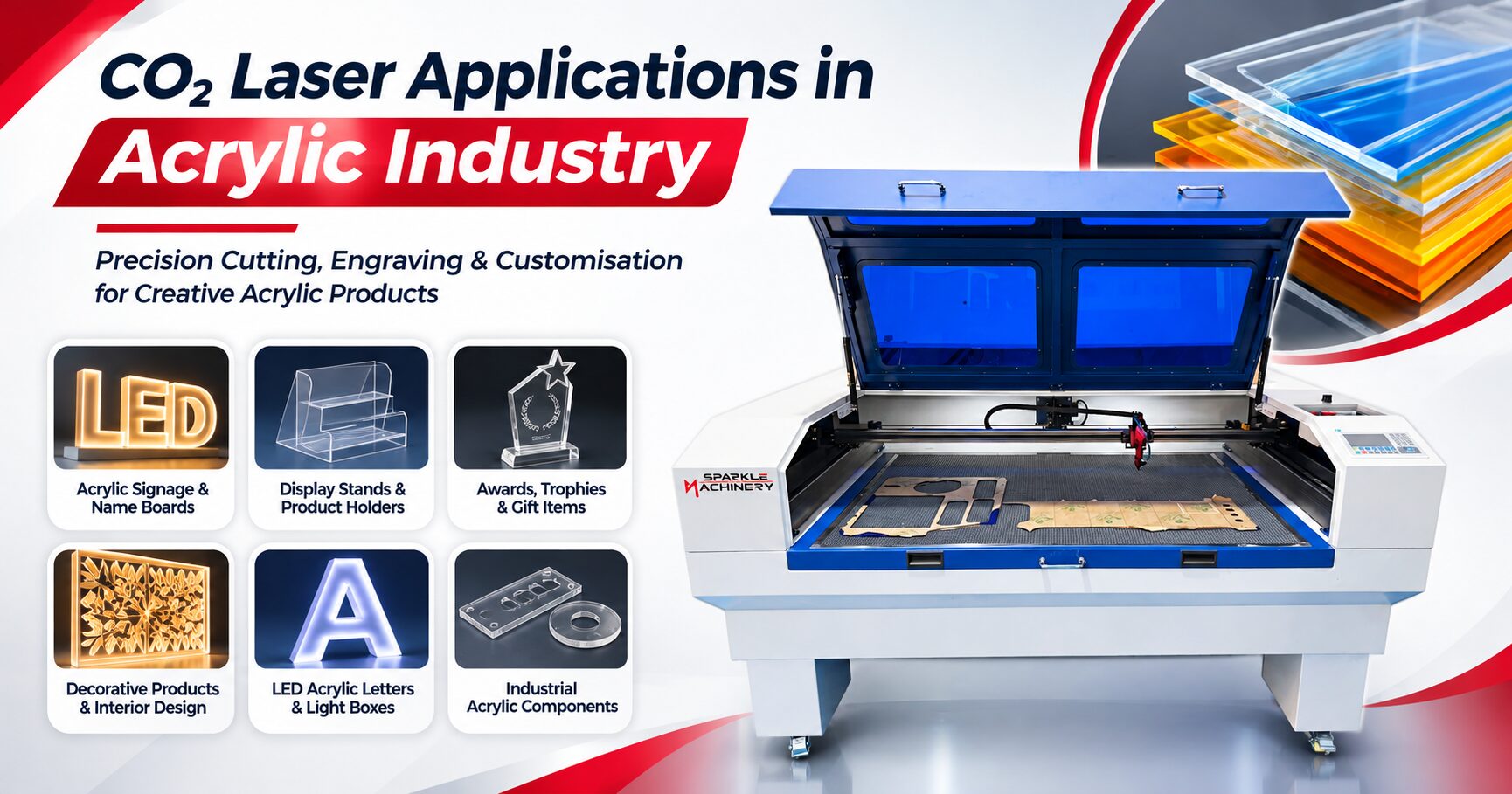
2. Major CO₂ Laser Applications in the Acrylic Industry
CO₂ laser cutting and engraving technology supports a wide range of acrylic manufacturing applications.
A. Acrylic Signage and Name Boards
Acrylic signage is widely used in offices, retail stores, shopping malls, hospitals, hotels and commercial spaces.
A CO₂ laser cutting machine helps manufacturers create:
- Company name boards
- Office signage
- Directional signs
- Reception nameplates
- LED acrylic letters
- Customised promotional signs
The technology allows manufacturers to cut letters, logos and decorative shapes accurately, helping create professional-looking signage products.
B. Acrylic Display Stands and Product Holders
Retail businesses use acrylic display products to present their products in an organised and attractive way.
CO₂ laser cutting machines are used to manufacture:
- Cosmetic display stands
- Mobile phone display holders
- Jewellery display units
- Retail product stands
- Brochure holders
- Countertop display products
The ability to cut different shapes and sizes makes laser technology suitable for customised display manufacturing.
C. Acrylic Awards, Trophies and Gift Items
Personalised awards and decorative gifts are popular in corporate events, educational institutions, exhibitions and celebrations.
CO₂ laser cutting and engraving machines can be used to produce:
- Acrylic trophies
- Corporate awards
- Customised photo frames
- Personalised gift items
- Decorative plaques
- Event souvenirs
Laser engraving can add names, logos, messages, serial numbers and other designs to suitable acrylic surfaces.
D. Acrylic Decorative Products and Interior Design
Acrylic is commonly used in interior decoration because of its appearance and design flexibility.
CO₂ laser technology helps manufacturers create:
- Decorative wall panels
- Acrylic partitions
- Customised interior elements
- Decorative lighting components
- Acrylic wall art
- Designer furniture components
Complex patterns and customised shapes can be produced according to design requirements.
E. LED Acrylic Letters and Light Boxes
LED signage manufacturers use acrylic to create illuminated letters, logos and display panels.
CO₂ laser cutting machines support the production of:
- LED channel letter components
- Acrylic light box panels
- Backlit signage
- Illuminated logos
- Decorative lighting panels
Accurate cutting helps manufacturers achieve consistent dimensions and better-fitting components during assembly.
F. Industrial Acrylic Components
Apart from decorative applications, acrylic is also used for certain industrial and commercial components.
CO₂ laser cutting machines can process suitable acrylic parts such as:
- Machine covers and protective panels
- Control panel overlays
- Equipment identification plates
- Transparent display covers
- Customised industrial components
Material suitability and required tolerances should always be evaluated before production.
3. CO₂ Laser Cutting vs Traditional Acrylic Cutting
Traditional acrylic processing methods include mechanical cutting, sawing and manual shaping. These methods can be useful for specific applications, but intricate designs and repeated customised production may require more time and manual effort.
| Comparison | CO₂ Laser Cutting | Traditional Cutting |
| Cutting accuracy | High, with suitable configuration | Depends on tools and operator |
| Complex designs | Suitable for intricate patterns | May require additional operations |
| Mechanical contact | Non-contact process | Usually involves tool contact |
| Customisation | Flexible design changes | May require tool or setup changes |
| Edge quality | Can produce smooth edges on suitable acrylic | Depends on cutting and finishing method |
| Batch production | Supports repeatable processing | Depends on workflow and setup |
The right method depends on material thickness, production volume, component design and required finish.
4. Acrylic Engraving Using CO₂ Laser Technology
Apart from cutting, CO₂ laser machines are also used for engraving designs on suitable acrylic surfaces.
Acrylic laser engraving can create frosted or matte-looking effects, depending on the material and processing parameters.
Common engraving applications include:
- Company logos
- Brand names
- Serial numbers
- Product information
- Customised messages
- Decorative patterns
- Promotional graphics
Laser engraving is particularly useful for manufacturers producing personalised products, corporate gifts and customised signage.
Important: Acrylic materials can respond differently to laser processing. Cast and extruded acrylic may produce different engraving results. Testing the material before bulk production is recommended.
5. Benefits of Using a CO₂ Laser Cutting Machine for Acrylic Manufacturing
Investing in a suitable CO₂ laser cutting machine can help acrylic manufacturers improve their production capabilities.
Improved Production Efficiency
Automated laser processing reduces several manual cutting and shaping activities, helping manufacturers streamline their workflow.
Better Design Flexibility
Businesses can process different designs without depending entirely on conventional cutting tools. This is useful for customised orders and short production runs.
Consistent Cutting Quality
Once the correct parameters are established, the machine can produce repeatable results across multiple components.
Reduced Mechanical Tool Wear
Since laser cutting is a non-contact process, there is no conventional cutting tool making direct contact with the acrylic during processing.
Support for Customised Manufacturing
From simple nameplates to complex decorative designs, laser technology allows businesses to respond to different customer requirements.
6. How to Choose the Right CO₂ Laser Cutting Machine for Acrylic?
Selecting the correct machine is important for achieving the required cutting quality and production output.
Before purchasing a CO₂ laser cutting machine, consider the following factors:
1. Laser Power
Choose laser power based on the acrylic thickness, cutting speed and production requirements. Higher power does not automatically guarantee better results for every application.
2. Working Area
Select a working area that accommodates the maximum acrylic sheet or component size used in your production.
3. Cutting Thickness
Confirm the machine’s practical cutting capability for the acrylic grades and thicknesses you intend to process.
4. Motion and Control System
A reliable motion system and suitable control software help achieve accurate movement and repeatable cutting results.
5. Cooling System
CO₂ laser sources require appropriate cooling. Ensure that the cooling system is suitable for the laser source and operating conditions.
6. Exhaust and Air Assistance
Proper fume extraction is essential when processing acrylic. Air assistance also helps manage cutting conditions and edge quality.
7. Technical Support and After-Sales Service
Consider installation, operator training, maintenance support and availability of spare parts when selecting a laser machine manufacturer.
7. Safety Considerations While Laser Cutting Acrylic
Acrylic laser processing requires appropriate safety measures because it can generate fumes and heat.
Manufacturers should follow these precautions:
- Use suitable industrial fume extraction and ventilation.
- Never operate the laser without proper supervision.
- Maintain the recommended cooling and air-assistance systems.
- Keep the machine clean and inspect it regularly.
- Use only materials confirmed as suitable for laser processing.
- Avoid cutting unknown plastics or materials that may release hazardous fumes.
- Follow the machine manufacturer’s operating and maintenance guidelines.
Proper safety practices help create a safer and more reliable production environment.
8. How SM Laser Technology Supports Industrial Laser Applications
SM Laser Technology provides industrial laser machine solutions for businesses looking to improve their manufacturing processes.
With a focus on industrial laser technology, the company offers solutions across multiple applications, including:
- Fiber Laser Marking Machines
- CO₂ Laser Cutting Machines
- Fiber Laser Cutting Machines
- Laser Welding Machines
- Laser Cleaning Machines
- Customized Automation and SPM Solutions
For businesses working in the acrylic industry, selecting the right CO₂ laser cutting configuration depends on the material, sheet dimensions, cutting requirements and production volume.
SM Laser Technology helps businesses explore suitable laser machine solutions based on their application requirements.
Conclusion
CO₂ laser technology has become an important processing solution for the acrylic industry. From signage and display stands to trophies, decorative products and customised industrial components, a CO₂ laser cutting machine offers flexibility, precision and repeatable processing.
For acrylic manufacturers looking to improve production efficiency, expand customisation capabilities and meet changing customer demands, investing in the right laser technology can be a valuable step.
Looking for a suitable CO₂ laser cutting machine for your business?
Connect with SM Laser Technology to discuss your application requirements and explore suitable industrial laser solutions.
Frequently Asked Questions (FAQs)
1. Can a CO₂ laser cutting machine cut acrylic?
Yes. CO₂ laser cutting machines are commonly used to cut suitable acrylic sheets and create customised shapes, letters and designs.
2. Which acrylic is suitable for CO₂ laser cutting?
Both cast and extruded acrylic can be processed using CO₂ laser technology, but their cutting and engraving results may differ. Material testing is recommended.
3. Can a CO₂ laser machine engrave acrylic?
Yes. CO₂ laser machines can engrave suitable acrylic surfaces to create text, logos, patterns and customised designs.
4. What products can be manufactured using an acrylic laser cutting machine?
Common products include signage, name boards, display stands, trophies, awards, LED letters, decorative panels and customised acrylic components.
5. Is CO₂ laser cutting better than traditional acrylic cutting?
CO₂ laser cutting is particularly useful for intricate designs, customisation and repeatable production. The best method depends on the application, material thickness and production requirements.
6. What factors affect acrylic laser cutting quality?
Laser power, cutting speed, focus position, acrylic type, material thickness, air assistance and machine condition all influence cutting quality.
7. Can a CO₂ laser cutting machine support bulk production?
Yes. With suitable machine configuration and production planning, CO₂ laser cutting machines can support repeated and batch production.
8. How do I select the right CO₂ laser cutting machine?
Consider the required acrylic thickness, working area, laser power, production volume, cooling system, exhaust arrangement and after-sales technical support before purchasing.