The electronics manufacturing industry requires accurate, permanent and reliable product identification. From printed circuit boards (PCBs) to electronic components, manufacturers need marking solutions that provide clear information without affecting the functionality of sensitive components.
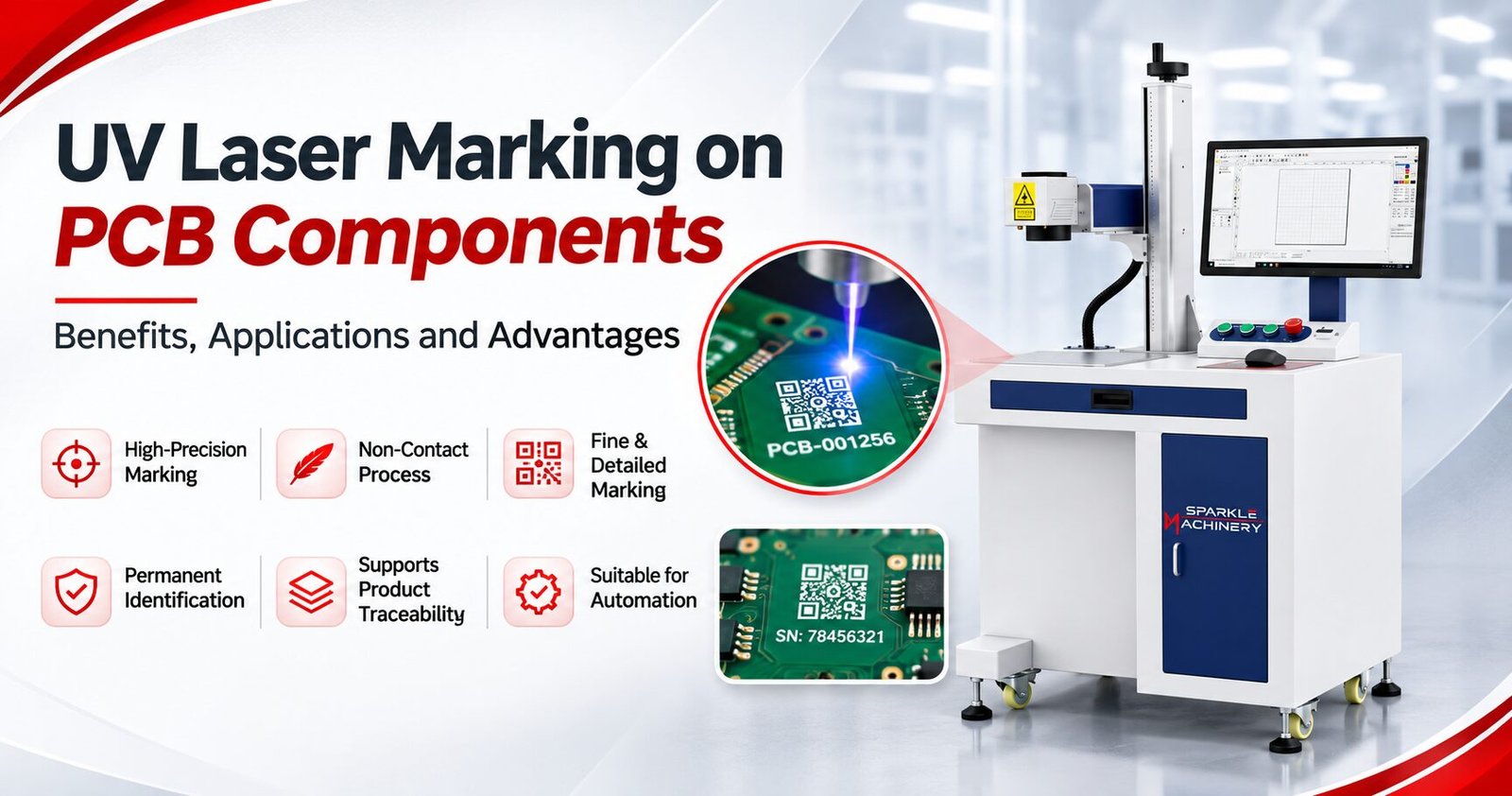
UV Laser Marking on PCB Components is an advanced marking technology used for applications such as component identification, serial numbers, QR codes, bar codes, logos and product traceability.
With its high precision and controlled marking capabilities, a UV Laser Marking Machine is a suitable solution for many electronics manufacturing applications where fine and detailed marking is required.
In this blog, we will explore how UV laser marking works, its benefits, applications and why it is becoming an important technology in modern electronics manufacturing.
What Is UV Laser Marking?
UV laser marking is a non-contact marking process that uses ultraviolet laser technology to create permanent marks on selected materials.
Unlike conventional marking methods, UV laser marking uses a shorter wavelength, generally 355 nm, allowing precise interaction with suitable materials.
It is particularly useful for applications that require fine details, small characters and high-quality marking.
UV laser marking can be used on selected PCB materials, electronic plastics, coated surfaces and other components, depending on their material composition and surface properties.
Why Is UV Laser Marking Used on PCB Components?
Printed Circuit Boards contain sensitive electronic components, tracks and connections. Therefore, marking must be performed carefully to avoid affecting the board’s functionality.
UV laser marking offers controlled marking capabilities and is suitable for applications that require:
- Small and detailed characters.
- Permanent product identification.
- QR code and barcode marking.
- Serial number marking.
- Component identification.
- Product traceability.
The suitability of UV laser marking depends on PCB material, solder mask, coating, component type and marking parameters. Testing is recommended before production.
Key Benefits of UV Laser Marking on PCB Components
1. High-Precision Marking
UV laser technology supports fine marking applications where small text, symbols, serial numbers and QR codes are required.
It is useful for electronic components that have limited marking space.
2. Non-Contact Marking Process
Laser marking does not require direct physical contact with the PCB surface.
This eliminates mechanical marking pressure and helps reduce the risk of physical damage associated with contact-based marking methods.
3. Fine and Detailed Marking
PCB components often require small characters and detailed identification marks.
UV laser marking can produce clear and accurate marks when the material and laser parameters are properly selected.
4. Permanent Identification
Laser marking creates durable identification marks suitable for product identification and traceability.
The durability of the mark depends on the material, marking method and operating environment.
5. Supports Product Traceability
Manufacturers can mark important information such as:
- Serial numbers
- QR codes
- Barcodes
- Manufacturing dates
- Batch numbers
- Product identification codes
This information helps manufacturers manage product identification, quality control and production tracking.
6. Suitable for Automation
UV laser marking systems can be integrated into suitable production workflows and automated manufacturing setups.
This helps manufacturers improve marking consistency and streamline production operations.
Applications of UV Laser Marking in the Electronics Industry
UV laser marking is used across different electronics manufacturing applications.
PCB Marking
UV laser marking can be used for marking identification codes, serial numbers, QR codes and other information on suitable PCB surfaces.
Electronic Component Marking
Selected electronic components can be marked with product codes, identification numbers and manufacturing information.
Semiconductor Component Identification
UV laser marking may be used for fine identification marking on compatible semiconductor packages and electronic components.
Connector and Switch Marking
Suitable plastic and coated connector surfaces, switches and electronic housings can be marked with logos, symbols and identification details.
Electronic Product Identification
Manufacturers can use laser marking for product identification on selected electronic housings, control panels and circuit board assemblies.
UV Laser Marking vs Traditional PCB Marking Methods
| Feature | UV Laser Marking | Traditional Printing |
| Marking process | Non-contact laser | Ink-based process |
| Precision | Suitable for fine details | Depends on printing method |
| Permanent marking | Generally durable, depending on material | Depends on ink and surface |
| Consumables | No marking ink required | Requires printing ink |
| Small codes | Suitable for fine codes | Depends on printing resolution |
| Automation | Can integrate with production systems | Can integrate with production systems |
The right marking method depends on the PCB material, production volume, marking requirements and cost considerations.
How to Choose the Right UV Laser Marking Machine for PCB Applications
Before selecting a UV Laser Marking Machine, manufacturers should evaluate the following factors:
1. Material Compatibility: Check whether the machine is suitable for the PCB substrate, solder mask, coating or electronic component material.
2. Marking Area: Select a suitable marking field according to the size and layout of the PCB components.
3. Marking Accuracy: Evaluate the required character size, QR code dimensions and marking detail.
4. Production Speed: Consider the number of PCBs or components that need to be marked per hour.
5. Automation Requirements: Determine whether manual loading, conveyor-based operation or automated integration is required.
6. Sample Testing: Always conduct marking trials to evaluate readability, contrast, surface quality and any possible thermal or material damage.
Why Choose SM Laser Technology for UV Laser Marking Solutions?
SM Laser Technology provides advanced industrial laser marking solutions for different manufacturing requirements.
Our laser marking solutions are designed to support applications that require precision, consistency and reliable product identification.
We offer laser marking machine solutions for industries looking to improve their marking processes and production efficiency.
Whether your requirement involves PCB identification, electronic component marking, QR code marking or product traceability, selecting the right laser technology and configuration is important.
Contact SM Laser Technology to discuss your application and explore suitable UV laser marking solutions.
Frequently Asked Questions (FAQs)
1. What is UV laser marking on PCB components?
UV laser marking is a non-contact process that uses ultraviolet laser technology to create identification marks, serial numbers, QR codes and other information on compatible PCB surfaces and electronic components.
2. Why is UV laser marking suitable for electronics manufacturing?
It supports fine marking, small characters and detailed identification. Its non-contact process also eliminates mechanical marking pressure.
3. Can UV laser marking be used on all PCB materials?
No. Compatibility depends on the PCB substrate, solder mask, coating and component material. Sample testing is recommended before production.
4. Can UV laser marking create QR codes on PCBs?
Yes. UV laser marking can create small QR codes and identification marks on suitable PCB surfaces, provided the required contrast and readability are achieved.
5. Is UV laser marking permanent?
UV laser marking can produce durable marks. However, mark durability depends on the material, marking parameters and environmental conditions.
6. What information can be marked on PCB components?
Manufacturers can mark serial numbers, batch numbers, QR codes, barcodes, manufacturing dates, logos and product identification codes.
7. How do I choose the right UV Laser Marking Machine?
Consider material compatibility, marking area, required precision, production speed, automation requirements and sample marking results before selecting a machine.
Conclusion
UV laser marking is an important technology for modern electronics manufacturing, offering high precision, non-contact processing and detailed product identification.
From PCB marking and electronic component identification to QR code marking and product traceability, UV laser technology supports a wide range of applications on compatible materials.
As electronics manufacturing continues to demand smaller components and more detailed identification, UV laser marking can play an important role in improving marking quality and production efficiency.
Looking for a UV Laser Marking Machine for your PCB or electronics manufacturing application?
Contact SM Laser Technology to discuss your requirements and book a machine demonstration.
Website: www.sparklemachinery.com