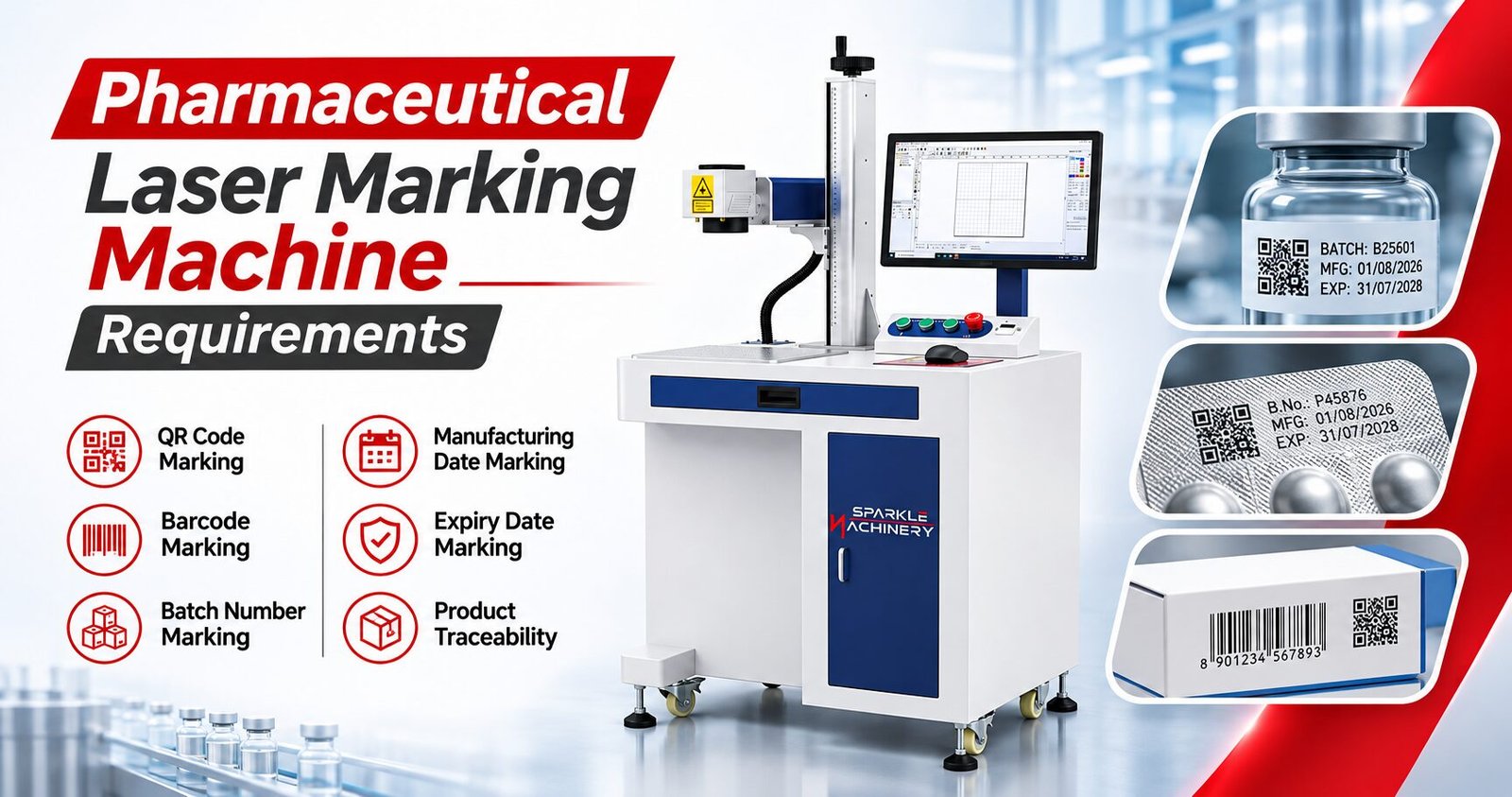
The pharmaceutical industry requires accurate product identification, reliable packaging information and effective traceability throughout the supply chain. Every medicine and pharmaceutical product must carry the relevant information needed for identification, verification and tracking.
As pharmaceutical manufacturing continues to adopt advanced technologies, laser marking machines are becoming an important option for permanent marking on suitable products, packaging materials and industrial components.
Pharmaceutical laser marking can be used for applications such as product identification, batch number marking, QR code marking, barcode marking and permanent identification of selected metal components.
In this blog, we will explore pharmaceutical laser marking requirements, common marking applications, different laser technologies and how pharmaceutical manufacturers can select a suitable laser marking machine.
1. What Is Pharmaceutical Laser Marking?
Pharmaceutical laser marking is a process that uses a controlled laser beam to create text, codes, symbols or identification marks on a suitable material.
Unlike conventional ink printing, laser marking can create permanent marks without requiring ink or labels for the marking itself.
Depending on the material and machine configuration, laser marking can be used for:
- Batch numbers
- Manufacturing dates
- Expiry dates
- Product identification codes
- QR codes
- Barcodes
- Serial numbers
- Company logos and identification symbols
Laser marking is useful when manufacturers require consistent, clear and durable identification marks.
2. Why Is Product Marking Important in the Pharmaceutical Industry?
Accurate product identification plays an important role in pharmaceutical manufacturing and packaging.
Pharmaceutical companies handle different products, batches and packaging formats. Correct identification helps manufacturers maintain organised production records and support product traceability.
Some important reasons for pharmaceutical product marking include:
A. Product Identification
Product codes, batch numbers and other identification details help distinguish one pharmaceutical product from another.
B. Batch Traceability
Batch numbers help manufacturers identify specific production batches and support quality investigations, distribution tracking and product recalls.
C. Product Authentication
QR codes and barcodes can store or link to product information that can be accessed through compatible scanning applications and systems.
D. Manufacturing Information
Manufacturing dates, expiry dates and other relevant information help distributors, retailers and customers identify important product details.
E. Improved Production Efficiency
Automated marking systems can help manufacturers maintain consistent marking across production batches and packaging operations.
3. Pharmaceutical Marking and QR Code Requirements in India
Pharmaceutical manufacturers in India must follow applicable requirements under the Drugs Rules, 1945 and relevant government notifications.
The rules include requirements for barcode or QR code identification for specified pharmaceutical products and packaging.
Some important provisions include:
A. Active Pharmaceutical Ingredients (APIs)
APIs manufactured or imported in India are required to carry QR codes at each level of packaging. The stored information includes product identification, API name, manufacturer details, batch number, manufacturing date, expiry or retesting date and other prescribed information.
B. Specified Drug Formulations
The Drugs Rules introduced barcode or QR code requirements for the top 300 brands of drug formulations listed under Schedule H2. The code is required on the primary packaging label or, where space is insufficient, on the secondary packaging label.
C. Expansion of Schedule H2 in 2026
On 25 June 2026, the Ministry of Health and Family Welfare announced an expansion of the QR code-based traceability framework to include vaccines, antimicrobials, narcotic and psychotropic drugs covered under the NDPS Act, and anti-cancer medicines.
The announced implementation dates are:
- Vaccines, narcotic and psychotropic drugs, and anti-cancer medicines: 1 July 2027.
- Antimicrobials: 1 July 2028.
The required QR code information includes product identification, drug names, manufacturer details, batch number, manufacturing and expiry dates, manufacturing licence number and applicable excipient details.
Manufacturers should consult the latest official notifications and applicable product-specific requirements before implementing a marking or packaging system.
4. What Information Can Be Marked on Pharmaceutical Products?
Pharmaceutical marking requirements depend on the product category, packaging type and applicable regulations.
Common information used for product identification includes:
| Marking information | Purpose |
| Batch Number | Identifies the manufacturing batch |
| Manufacturing Date | Indicates the production date |
| Expiry Date | Identifies the product’s expiry |
| QR Code | Stores or links to product information |
| Barcode | Supports product identification and scanning |
| Serial Number | Helps identify individual units where required |
| Product Code | Identifies the product |
| Manufacturer Details | Identifies the manufacturing company |
The actual data encoded in a barcode or QR code must follow the applicable regulatory and product requirements.
5. Types of Laser Marking Machines Used for Pharmaceutical Applications
Different pharmaceutical applications require different marking technologies. The correct machine depends on the marking material, required code size, production speed and marking quality.
A. Fiber Laser Marking Machine
A fiber laser marking machine is commonly used for marking suitable metal surfaces.
Applications include:
- Stainless steel pharmaceutical equipment
- Metal tools and components
- Machine identification plates
- Industrial equipment serial numbers
- Product identification codes on compatible metal parts
Fiber laser marking offers precise and permanent marking on suitable metals.
B. UV Laser Marking Machine
UV laser marking machines are suitable for applications requiring fine marking and controlled processing on compatible materials.
Potential applications include:
- Selected plastic pharmaceutical components
- Medical and pharmaceutical device components
- Fine identification marks
- Small QR codes and product codes on compatible surfaces
The marking result depends on the material composition, surface finish and laser parameters.
C. Enclosure Laser Marking Machine
An enclosure laser marking machine provides an enclosed marking area and is useful where a controlled marking workstation is required.
Depending on its configuration, it can support marking operations on suitable components and products.
D. Automated Laser Marking Machine
Automated laser marking systems can be integrated with conveyors, fixtures, sensors and production lines.
They are useful for manufacturers requiring repeatable marking operations and integration with existing manufacturing processes.
6. Important Factors When Choosing a Pharmaceutical Laser Marking Machine
Selecting the right pharmaceutical laser marking machine requires careful evaluation of the marking application.
Consider the following factors:
1. Material Compatibility
Identify whether the marking surface is stainless steel, aluminium, plastic, coated material, glass or another substrate.
Different materials require different laser wavelengths and processing parameters.
2. Marking Quality
The marking must be clear, consistent and suitable for the required identification or scanning process.
3. QR Code and Barcode Readability
If the application requires QR codes or barcodes, verify that the marked codes can be read consistently using the intended scanning equipment.
4. Production Speed
Consider the number of products marked per hour and whether the machine can meet your production requirements.
5. Integration with Production Lines
For automated operations, check compatibility with conveyors, fixtures, sensors, software and other production equipment.
6. Installation and Technical Support
Choose a machine supplier that can provide suitable installation guidance, operator training and after-sales technical support.
7. Benefits of Laser Marking for Pharmaceutical Manufacturing
Laser marking offers several potential advantages for suitable pharmaceutical manufacturing applications.
- Permanent marking: Marks can be durable and resistant to normal handling, depending on the material and process.
- No marking ink required: Laser marking itself does not require printing ink or ribbons.
- High precision: Suitable for small text, identification codes and detailed marks.
- Consistent results: Repeatable machine settings can support consistent marking quality.
- Automation compatibility: Laser marking systems can be integrated with production equipment.
- Reduced consumables: Can reduce the need for marking consumables such as ink and ribbons for compatible applications.
The actual benefits depend on the product, marking surface and production setup.
8. Laser Marking vs Traditional Printing in Pharmaceutical Applications
Both laser marking and conventional printing have important roles in pharmaceutical manufacturing.
| Parameter | Laser Marking | Conventional Printing |
| Marking method | Laser beam | Ink or printing material |
| Ink requirement | Not required for laser marking | Generally required |
| Mark durability | Often permanent on suitable materials | Depends on ink and surface |
| Precision | Suitable for fine marking | Depends on printing technology |
| Automation | Can be integrated with automated systems | Can be integrated with packaging lines |
| Material suitability | Depends on laser wavelength and material | Depends on ink and printing method |
The choice should be based on the packaging material, regulatory requirements, production speed and code readability.
Important: Laser marking is not automatically a replacement for pharmaceutical label printing. If a regulation requires a barcode or QR code to be printed or affixed on a packaging label, manufacturers must ensure that their selected process meets that requirement. Direct laser marking should only be used where the applicable rules and validated packaging process permit it.
9. Quality and Validation Considerations
Pharmaceutical manufacturing requires controlled processes and documented quality procedures.
Before introducing a laser marking system, manufacturers should consider:
- Testing the marking on actual production materials.
- Verifying barcode and QR code readability.
- Establishing suitable laser parameters.
- Checking marking consistency across production batches.
- Maintaining machine operating and maintenance records.
- Validating the marking process as part of the applicable quality system.
- Ensuring that marking does not damage the product or compromise packaging integrity.
For regulated pharmaceutical production, the marking process should be reviewed and approved by the company’s quality and regulatory teams.
10. Why Choose SM Laser Technology for Laser Marking Solutions?
SM Laser Technology offers industrial laser marking solutions for different manufacturing applications.
Our product range includes:
- Fiber Laser Marking Machines
- UV Laser Marking Machines
- Enclosure Laser Marking Machines
- Portable Laser Marking Machines
- CO2 Laser Marking Machines
- 3-Axis Laser Marking Machines
- Fly-with-Conveyor Marking Machines
- Customized Industrial Laser Automation Solutions
We help businesses explore suitable laser marking solutions based on their material, marking requirements and production applications.
If you are looking for a laser marking machine for pharmaceutical components, equipment identification or compatible packaging applications, our team can help you understand the available options.
Conclusion
Pharmaceutical laser marking plays an important role in modern product identification and industrial manufacturing.
With increasing attention to QR codes, barcode identification, batch traceability and product authentication, pharmaceutical manufacturers need reliable marking and coding processes.
Fiber laser marking machines, UV laser marking machines and automated laser marking systems offer different possibilities depending on the material and application.
Before selecting a machine, it is important to evaluate material compatibility, code readability, production speed and applicable regulatory requirements.
Looking for a Laser Marking Machine for Your Pharmaceutical Application?
Contact SM Laser Technology to discuss your marking requirements and explore suitable industrial laser marking solutions.
Website: https://sparklemachinery.com/