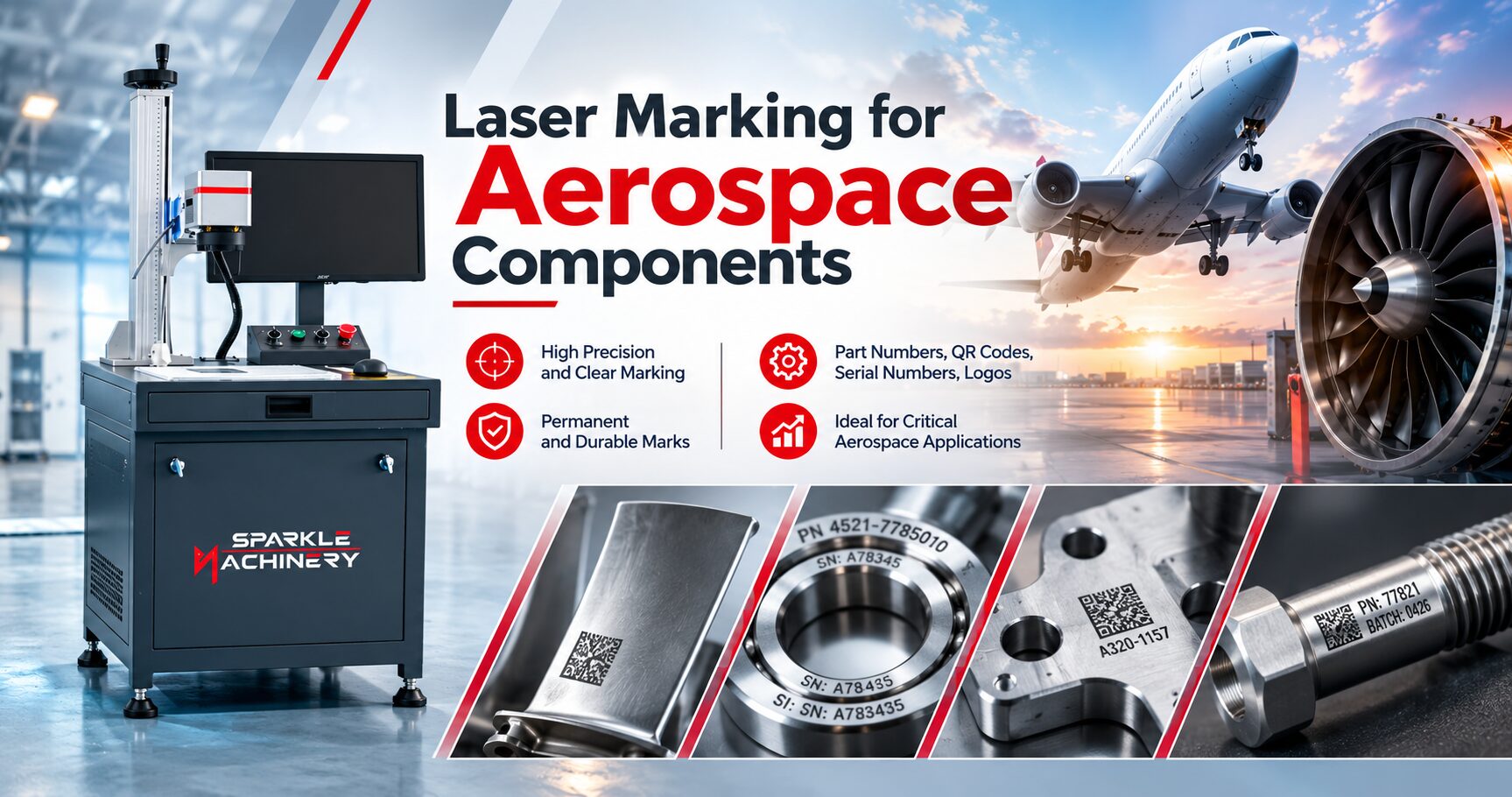
The aerospace industry demands exceptional levels of precision, reliability, traceability, and quality control. Every component, from engine parts and brackets to fasteners and electrical components, may need permanent identification throughout its lifecycle.
Traditional marking methods can struggle to provide the required combination of durability, precision, and consistency. This is where laser marking for aerospace components offers an advanced and reliable solution.
With modern fiber laser marking machines, manufacturers can create permanent, high-contrast markings on a wide range of aerospace materials without compromising component integrity.
Why Laser Marking Is Important in the Aerospace Industry
Aerospace components often need identification that remains readable under demanding operating and environmental conditions.
Laser marking can be used to create:
- Part numbers
- Serial numbers
- QR codes
- Data Matrix codes
- Barcodes
- Manufacturing dates
- Batch or lot numbers
- Company logos
- Inspection and identification codes
- Traceability information
Permanent identification helps manufacturers track components from production and inspection to assembly, maintenance, and service.
Key Benefits of Laser Marking for Aerospace Components
1. Permanent and Durable Marking
Aerospace components can be exposed to heat, chemicals, abrasion, vibration, and harsh operating environments.
Laser marking produces a permanent mark that can provide excellent resistance to wear and environmental conditions, helping identification remain readable throughout the component’s service life.
2. High-Precision Marking
Aerospace manufacturing requires extremely accurate identification.
A fiber laser marking machine can produce fine text, codes, graphics, and detailed patterns with high repeatability. This makes it suitable for small components where marking space is limited.
3. Non-Contact Process
Laser marking is a non-contact marking process. The laser beam marks the surface without requiring physical contact between a marking tool and the component.
This can help reduce mechanical stress, tool wear, and the risk of deformation associated with some traditional marking processes.
4. Excellent Traceability
Traceability is a critical requirement in aerospace manufacturing.
Unique serial numbers, Data Matrix codes, and QR codes can connect a physical component with important production information such as:
- Manufacturing batch
- Material information
- Inspection records
- Production date
- Quality-control data
- Maintenance history
This creates a reliable identification system throughout the component lifecycle.
5. High-Speed Production
Modern industrial laser marking machines can mark components quickly and consistently.
For manufacturers handling large production volumes, laser marking can help improve productivity while maintaining consistent marking quality.
6. Low Consumable Requirement
Unlike some conventional marking methods, laser marking generally does not require physical marking tools, inks, or labels.
This can reduce consumable requirements and help create a cleaner production process.
Aerospace Materials Suitable for Laser Marking
Different aerospace components are manufactured using different metals and engineering materials. Laser marking parameters can be optimized according to the material and required marking quality.
Common applications include:
Stainless Steel
Fiber laser marking can produce clear and durable identification on stainless-steel aerospace components.
Aluminium
Laser marking can be used for identification, serial numbers, codes, and other information on aluminium components.
Titanium
Titanium is widely used in aerospace applications because of its strength-to-weight characteristics. Laser marking can provide precise identification without traditional mechanical engraving.
Brass and Copper
Specialized laser parameters can be used for marking certain non-ferrous metals used in aerospace electrical and mechanical applications.
Coated and Anodized Components
Laser marking can also be applied to certain coated or anodized surfaces, depending on the coating and required marking result.
Common Aerospace Applications for Laser Marking
Laser marking technology can support identification and traceability across many aerospace manufacturing processes.
Typical applications include:
Aircraft Components
- Structural components
- Brackets
- Panels
- Mounting components
- Precision machined parts
Engine & Mechanical Components
- Engine components
- Fasteners
- Shafts
- Bushes
- Bearings
- Mechanical assemblies
Electrical & Electronic Components
- Connectors
- Switches
- Electrical housings
- Control components
- Identification plates
Tools & Equipment
- Aerospace tooling
- Inspection tools
- Fixtures
- Maintenance equipment
Laser Marking for Aerospace Traceability
One of the most important applications is component traceability.
A small Data Matrix or QR code can store or link to important information about a component. When scanned during production, inspection, assembly, or maintenance, the code can help identify the component and retrieve its associated records.
This supports better:
- Quality control
- Inventory management
- Production tracking
- Maintenance management
- Recall management
- Regulatory compliance
For aerospace manufacturers, this level of traceability can play an important role in maintaining quality throughout the supply chain.
Fiber Laser Marking Machine for Aerospace Applications
A fiber laser marking machine is particularly suitable for many aerospace applications because of its high precision, speed, and ability to mark a wide variety of metal surfaces.
Depending on the application, manufacturers can select different laser power levels, marking lenses, work areas, and automation configurations.
For example, a production line may require an automated laser marking system integrated with:
- Conveyor systems
- Vision inspection
- Barcode/QR code verification
- Rotary marking attachments
- Robotic loading and unloading
- Customized fixtures
- MES or production tracking systems
This allows laser marking to become part of a complete industrial laser automation solution rather than functioning as a standalone process.
Laser Marking vs Traditional Marking Methods
Compared with methods such as dot peen, stamping, or mechanical engraving, laser marking can offer several advantages for aerospace applications.
| Feature | Laser Marking | Traditional Mechanical Marking |
| Contact | Non-contact | Usually contact-based |
| Precision | Very high | Moderate to high |
| Small codes | Excellent | More challenging |
| Tool wear | Minimal | Higher |
| Consumables | Low | Can be higher |
| Automation | Highly suitable | Suitable |
| Complex graphics | Excellent | Limited |
| Traceability codes | Excellent | Depends on process |
The ideal marking technology ultimately depends on the material, component geometry, required mark depth, production volume, and customer specifications.
What to Consider Before Choosing an Aerospace Laser Marking Machine
Selecting the right machine requires more than simply choosing laser power.
Manufacturers should consider:
Material
Identify the metals, coatings, and surface finishes that need to be marked.
Marking Size
Determine the required marking area and component dimensions.
Marking Type
Decide whether you need text, logos, serial numbers, barcodes, Data Matrix codes, or deep engraving.
Production Volume
High-volume manufacturing may require automated or conveyor-based laser marking systems.
Traceability Requirements
If components require unique identification, the machine should support reliable code generation and integration.
Automation
For large-scale manufacturing, customized laser automation solutions can improve productivity and reduce manual handling.
Why Choose SM Laser Technology for Aerospace Laser Marking?
At SM Laser Technology, we provide industrial laser solutions designed around specific manufacturing requirements.
Our solutions can support applications including:
- Laser marking
- Laser engraving
- Industrial component identification
- QR and Data Matrix marking
- Metal marking
- Customized laser automation
- Application development
- Machine installation and training
- Technical and after-sales support
We focus not only on supplying a laser marking machine, but also on understanding the application and helping manufacturers achieve the required marking quality and production efficiency.
Conclusion
Aerospace manufacturing requires identification systems that are precise, permanent, reliable, and traceable. Laser marking provides a flexible solution for marking critical information on a wide range of aerospace components.
From serial numbers and part numbers to QR codes and Data Matrix codes, modern fiber laser marking machines can help aerospace manufacturers improve traceability, quality control, and production efficiency.
With the right machine, parameters, fixtures, and automation, laser marking can become an important part of a modern aerospace manufacturing process.