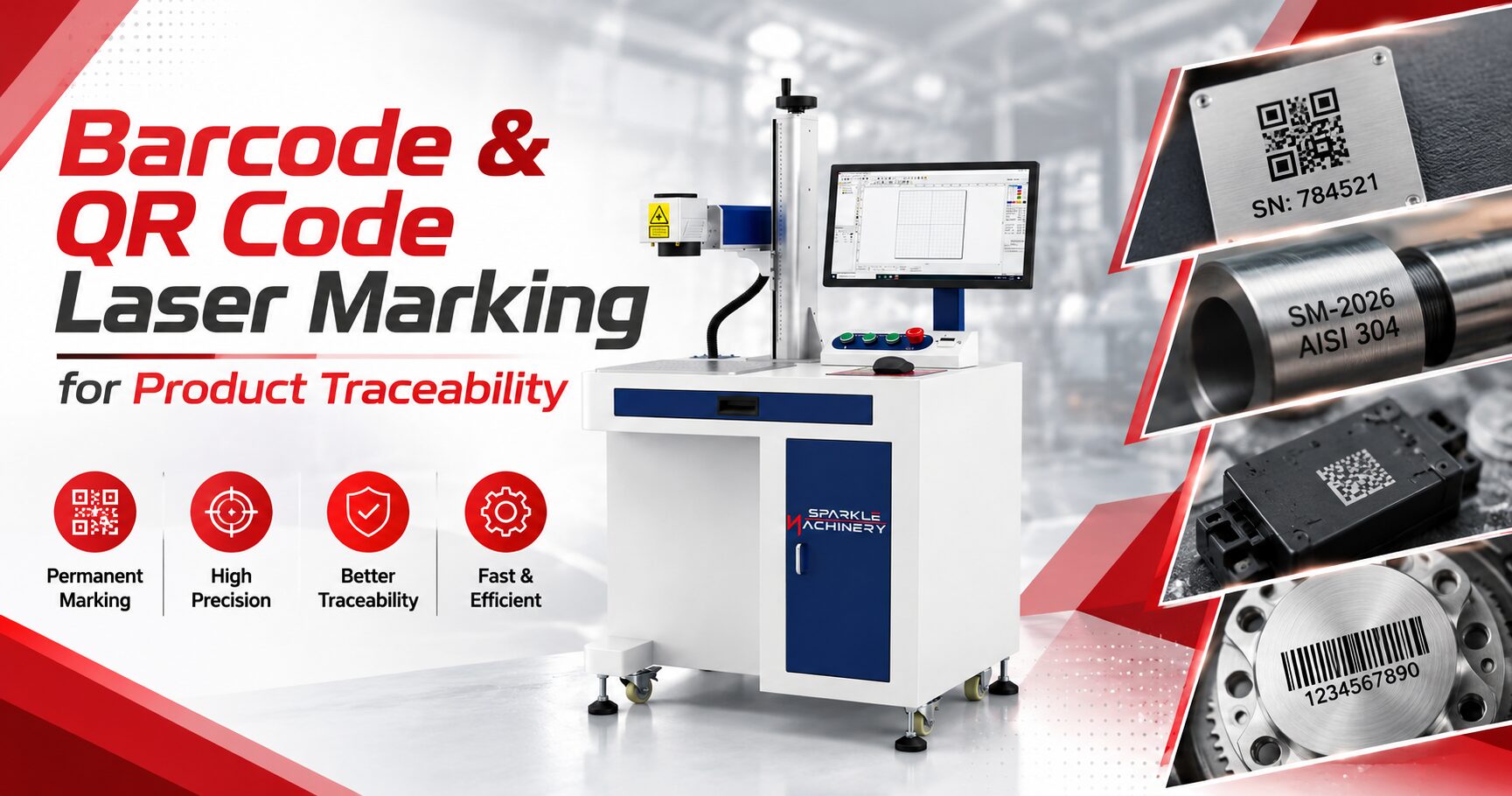
In today’s manufacturing industry, product identification and traceability are essential for quality control, inventory management, and customer confidence. Manufacturers need reliable ways to identify individual components, track production batches, and maintain accurate product records. This is where barcode and QR code laser marking plays an important role.
A laser marking machine creates precise markings directly on suitable materials, helping manufacturers identify products throughout their lifecycle. From automotive components and engineering parts to electrical products and industrial equipment, laser marking supports consistent and reliable product identification.
At SM Laser Technology, we provide advanced laser marking solutions designed for industrial applications, including marking barcodes, QR codes, Data Matrix codes, serial numbers, logos, and product information.
What Is Product Traceability?
Product traceability is the ability to identify and track a product or component throughout its manufacturing, distribution, and service lifecycle.
It helps manufacturers determine where a product was manufactured, which production batch it belongs to, and what identification information is associated with it.
For example, an automotive component may carry a unique serial number or Data Matrix code. When scanned, the code can connect the component to relevant information stored in a company’s traceability system, such as its production batch, inspection records, or manufacturing date.
An effective product traceability system can help businesses improve quality control, manage product recalls, reduce identification errors, and maintain accurate production records.
What Is Barcode & QR Code Laser Marking?
Barcode and QR code laser marking uses a focused laser beam to create codes directly on a suitable product surface. Depending on the material and laser parameters, the process can change the surface appearance, create contrast, or produce an engraved mark.
Unlike conventional ink-based marking, laser marking can create durable identification without requiring printing ink or labels for the mark itself.
Two common types of machine-readable codes used in industrial manufacturing are:
1. Barcode Laser Marking
A barcode typically represents information using a pattern of parallel lines and spaces. Depending on the barcode format, it can store an identification number or other encoded information.
A barcode laser marking machine is useful for applications such as:
- Product identification and inventory tracking
- Batch and lot number marking
- Manufacturing date and part number marking
- Component identification
- Asset tracking
The readability of a laser-marked barcode depends on the code format, marking quality, material, surface condition, and scanning system.
2. QR Code Laser Marking
A QR code is a two-dimensional code that can store more information than a typical linear barcode of comparable size. It can encode text, identification data, and website URLs, among other information types.
QR code laser marking is commonly considered for:
- Product identification
- Equipment and asset tracking
- Access to digital product information
- Component traceability
- Linking products to digital records
For industrial applications requiring compact codes, a QR code or Data Matrix code may be more suitable than a traditional linear barcode.
How Laser Marking Improves Product Traceability
Laser marking supports traceability by placing identification directly on the component or product, where the mark can remain available throughout handling and use.
Permanent Product Identification
A properly selected laser marking process can create durable marks that resist normal handling and wear. The actual durability depends on the material, marking method, and operating environment.
Unique Serial Numbers
Manufacturers can mark individual components with unique serial numbers to distinguish one part from another. This is particularly useful in automotive, engineering, electronics, and equipment manufacturing.
Batch and Lot Tracking
Batch numbers and lot codes help manufacturers connect products to specific production runs. This can simplify quality investigations and support more efficient product recall procedures.
Improved Data Accuracy
Machine-readable codes reduce dependence on manually entered identification details. When integrated with suitable scanning software and production databases, they can help reduce data-entry errors.
Support for Digital Traceability
A marked QR code or Data Matrix code can act as a link between a physical component and its digital record. However, the associated data must be maintained in a connected database or software system; the laser marking machine does not automatically create a complete traceability system by itself.
How Does a Laser Marking Machine Work?
A laser marking machine directs a focused laser beam onto a selected surface. The laser interacts with the material to produce the required mark.
The marking result depends on factors such as laser power, marking speed, frequency, focus, material composition, and the required contrast.
A typical barcode or QR code laser marking workflow includes the following steps:
- Create the code: Generate the barcode, QR code, Data Matrix code, or serial number using compatible marking software.
- Configure the marking parameters: Select suitable settings based on the material and required marking quality.
- Position the component: Place the component correctly within the marking area or use an appropriate fixture.
- Mark the code: The laser creates the selected pattern on the surface.
- Verify readability: Scan the marked code and confirm that it can be decoded correctly.
- Connect with traceability software: Where required, link the code to the relevant product record in the manufacturing or inventory system.
Testing the marked code on the actual production material is important before implementing the process at scale.
Choosing the Right Laser Marking Machine for Barcode and QR Code Applications
Selecting the right machine depends on the material, code size, production volume, marking speed, and required readability.
Fiber Laser Marking Machine
A fiber laser marking machine is widely used for industrial marking on suitable metals, including stainless steel, mild steel, aluminium, brass, and other compatible materials.
It is commonly considered for:
- Automotive components
- Engineering parts and tools
- Electrical and electronic components
- Metal product identification
- Serial numbers, barcodes, QR codes, and Data Matrix codes
SM Laser Technology’s fiber laser marking range includes machines designed for industrial marking applications, with different power options and configurations. The appropriate model depends on the application requirements.
UV Laser Marking Machine
A UV laser marking machine can be suitable for fine marking on certain plastics, electronic components, and heat-sensitive materials. Its suitability depends on the specific material and required result.
It may be considered when a manufacturer needs high-detail codes or when a conventional marking process does not provide the required contrast or surface quality.
CO₂ Galvo Laser Marking Machine
A CO₂ galvo laser marking machine is commonly used for compatible non-metal materials, including certain plastics, wood, acrylic, paper, and packaging materials.
It may be useful for product coding and identification where the material responds appropriately to the CO₂ laser wavelength.
Important: Always confirm material compatibility and test the actual code readability before choosing a machine.
Applications Across Different Industries
Barcode and QR code laser marking can support traceability across several manufacturing sectors.
Automotive Industry
Laser marking can identify engine components, metal parts, tools, and other automotive products using serial numbers, barcodes, or Data Matrix codes. These identifiers can connect components to production and quality records.
Electrical & Electronics Industry
Manufacturers can mark suitable components, housings, connectors, and equipment with product IDs, QR codes, and serial numbers to support identification and inventory control.
Engineering & General Manufacturing
Industrial tools, machine components, metal parts, and equipment can carry permanent identification to support maintenance records, stock management, and component tracking.
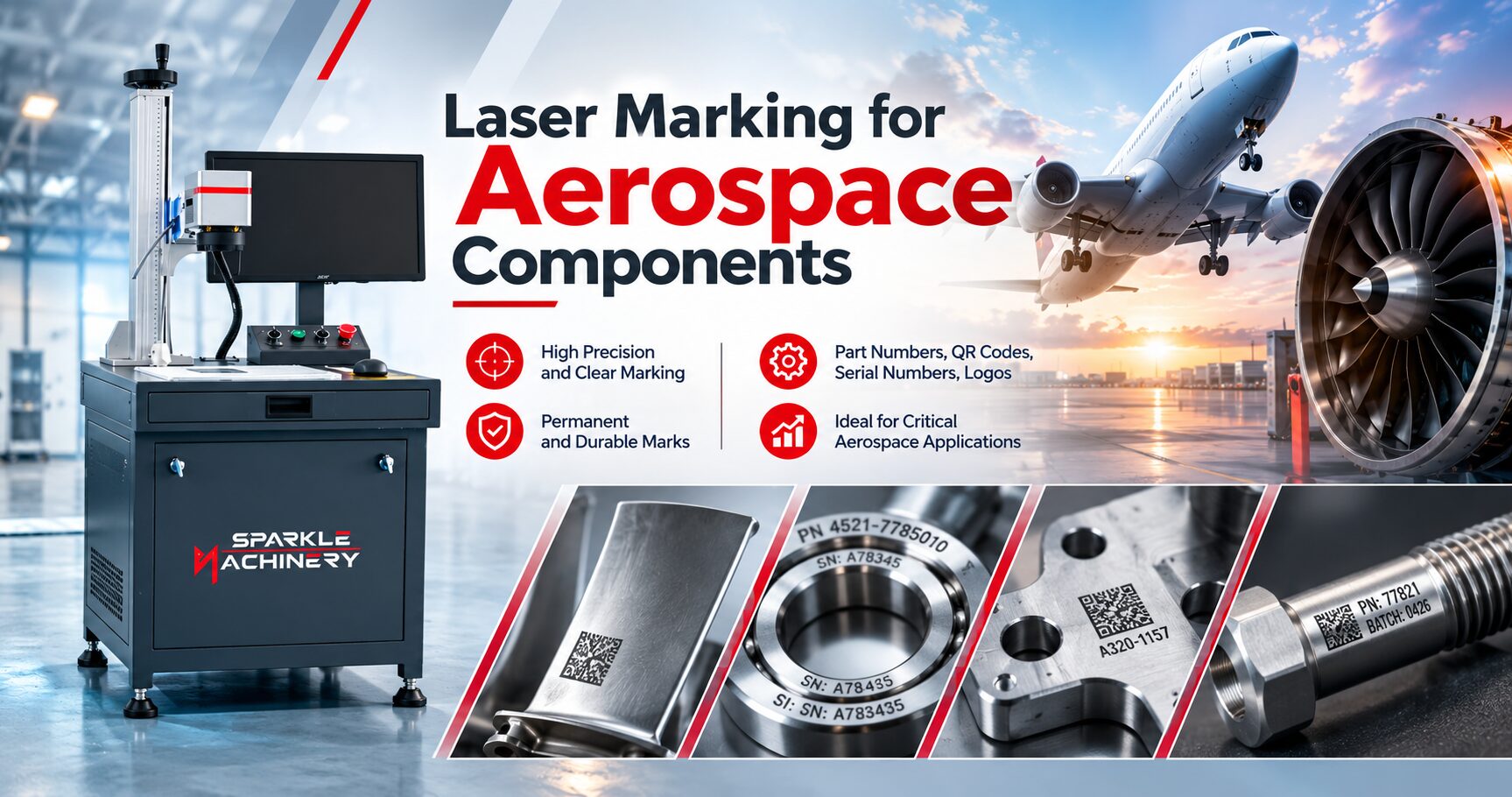
Aerospace Industry
Aerospace manufacturers may require durable, machine-readable identification on selected components. The marking process must meet the applicable material, quality, and industry requirements.
Medical Device Manufacturing
Laser marking may be used for identification on compatible medical devices and instruments. Any required regulatory or unique-device-identification standards must be verified for the particular product and market.
Benefits of Laser Marking for Product Traceability
The key benefits of a suitable laser marking system include:
- Durable identification: Creates marks designed to remain readable under appropriate operating conditions.
- High precision: Supports the marking of compact codes and detailed identification information.
- Consistent marking: Helps maintain repeatable results when the process is properly configured.
- No ink required for the laser mark: Eliminates printing ink for the marking operation itself.
- Production integration: Can be integrated into suitable manufacturing workflows and automated marking systems.
- Flexible coding: Supports serial numbers, batch codes, logos, barcodes, QR codes, and Data Matrix codes, depending on the machine and software.
- Better traceability workflows: Helps connect physical products with digital manufacturing and inventory records.
The actual results depend on the machine configuration, material, production environment, and traceability software.
What Should You Check Before Implementing Laser-Marked Codes?
Before selecting an industrial laser marking system, consider these important factors:
- Material compatibility: Confirm that the selected laser can produce a suitable mark on your product.
- Code size and content: Determine the required barcode or QR code dimensions and the amount of information to encode.
- Scanning performance: Verify that the code can be scanned reliably under actual production conditions.
- Production speed: Check whether the machine can meet your required production cycle time.
- Marking area: Choose a suitable marking area for the component size and fixture arrangement.
- Automation requirements: Consider conveyor marking, part positioning, code generation, and database integration if needed.
- Quality requirements: Establish an appropriate code verification process based on your industry and application.
- Technical support: Consider installation, operator training, application testing, and after-sales support.
Why Choose SM Laser Technology?
SM Laser Technology offers laser marking solutions for industrial applications, including fiber laser marking machines, UV laser marking machines, portable laser marking machines, and other marking configurations.
Our machines can support applications involving logos, text, serial numbers, barcodes, QR codes, and Data Matrix codes, depending on the model and application.
We help manufacturers evaluate their marking requirements and identify a suitable solution based on the material, code specifications, production needs, and required marking quality.
Our support includes application guidance, machine selection, installation, operator training, and after-sales technical assistance.
Whether you need a fiber laser marking machine for metal components or another laser marking solution for your product identification process, our team can help you assess the available options.
Conclusion
Barcode and QR code laser marking is an important technology for manufacturers seeking durable product identification and improved traceability workflows. By marking suitable products with machine-readable codes, businesses can connect physical components to digital records, support quality management, and improve inventory and production tracking.
Choosing the right laser marking machine requires careful evaluation of the material, code size, marking quality, production speed, and integration requirements.