In modern manufacturing, surface cleaning is an important step in maintaining product quality, improving welding performance, and preparing components for further processing.
Rust, paint, oil, grease, oxide layers, carbon deposits, and other contaminants can affect the performance and appearance of metal components. Traditionally, industries have used chemical cleaning, solvents, abrasive methods, and manual cleaning processes.
Today, industrial laser cleaning is becoming an increasingly useful alternative for applications that require precision, consistency, and controlled surface treatment.
But how does laser cleaning compare with chemical cleaning? And which method is right for your manufacturing process?
Let’s understand the key differences.
What Is Laser Cleaning?
Laser cleaning is a non-contact surface cleaning process that uses concentrated laser energy to remove unwanted material from a component’s surface.
Depending on the material and application, laser cleaning can be used for removing:
- Rust and corrosion
- Paint and coatings
- Oxides
- Oil and grease
- Carbon deposits
- Welding residue
- Surface contaminants
- Old coatings and buildup
A laser cleaning machine allows the operator to control parameters such as laser power, scanning speed, frequency, and cleaning pattern according to the application.
This makes laser cleaning suitable for applications where precision and repeatability are important.
What Is Chemical Cleaning?
Chemical cleaning uses specially selected chemicals, solvents, acids, alkaline solutions, or cleaning agents to remove contaminants from a component.
Depending on the application, parts may be:
- Immersed in chemical solutions
- Sprayed with cleaning agents
- Manually wiped
- Washed and rinsed
- Dried before the next process
Chemical cleaning can be effective for many industrial applications, particularly where large quantities of small components can be processed together.
However, chemical cleaning also requires appropriate procedures for chemical handling, storage, ventilation, worker safety, and waste management.
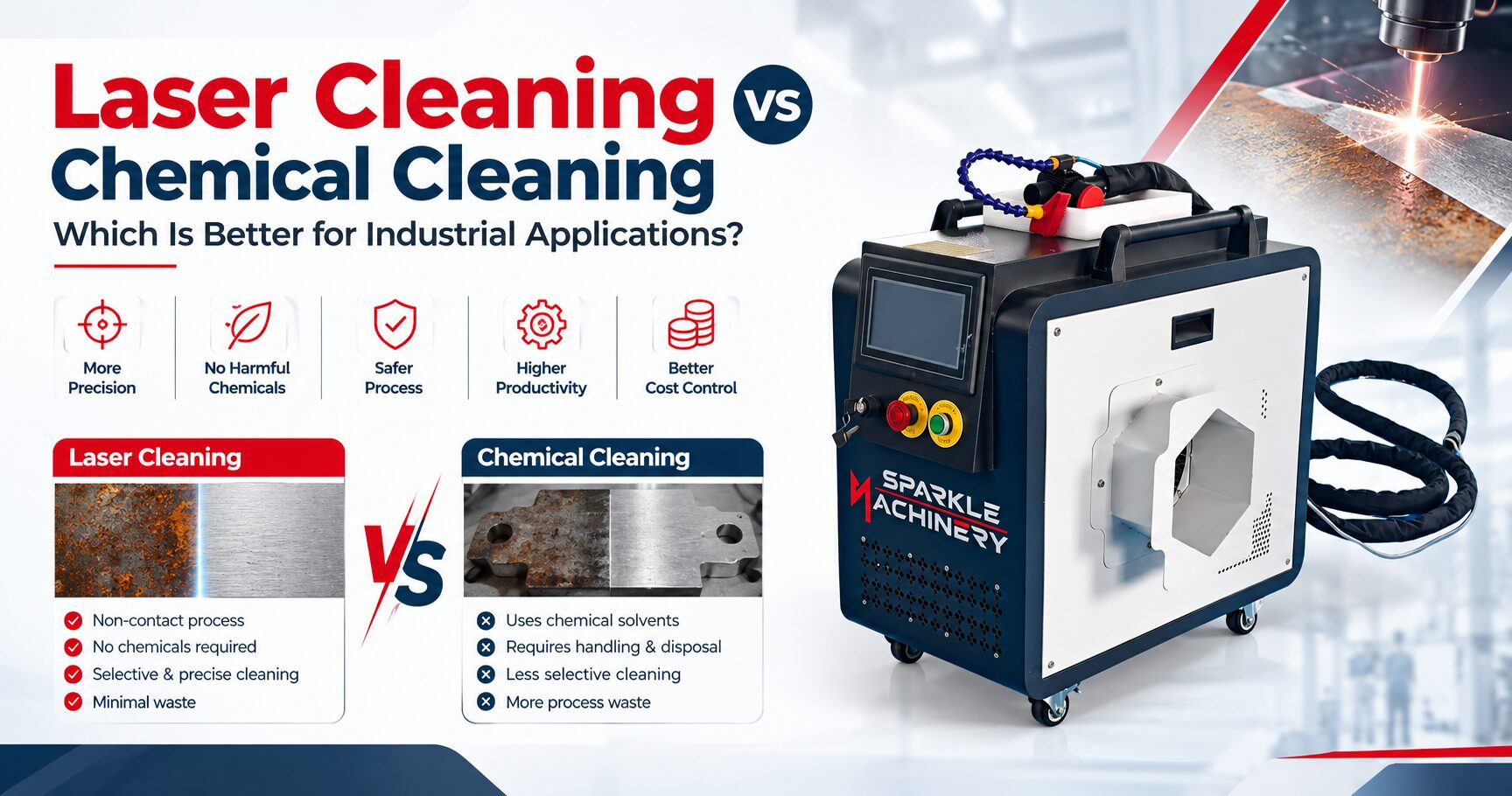
Laser Cleaning vs Chemical Cleaning
The two technologies work in fundamentally different ways.
| Parameter | Laser Cleaning | Chemical Cleaning |
| Cleaning method | Laser energy | Chemical reaction |
| Contact with component | Non-contact | Usually contact/immersion |
| Chemical requirement | No cleaning chemicals required | Cleaning chemicals required |
| Abrasive media | Not required | Generally not required |
| Precision | Highly controllable | Depends on chemical process |
| Selective cleaning | Possible | More difficult in many applications |
| Process waste | Mainly removed contaminants | Chemical waste and wastewater may be generated |
| Automation | Easy to integrate with automation | Automation possible depending on process |
| Maintenance | Generally low consumable requirement | Regular chemical replenishment |
| Initial investment | Higher | Generally lower |
| Internal cavities | Limited by laser access | Can be suitable for immersion cleaning |
The actual suitability of either process depends on the material, contaminant, component geometry, production volume, required finish, and application requirements.
1. Precision Cleaning
One of the biggest advantages of laser surface cleaning is process control.
A laser beam can be directed toward a specific area of a component. This allows manufacturers to clean selected sections instead of treating the entire component.
This can be particularly useful for:
- Weld preparation
- Localized rust removal
- Coating removal
- Component repair
- Surface preparation
- Precision manufacturing
Chemical cleaning generally exposes the component to the cleaning solution, making localized treatment more difficult in some applications.
2. Laser Cleaning Without Chemical Solvents
A fiber laser cleaning machine can remove many contaminants without using chemical solvents or abrasive materials.
This can help manufacturers reduce their dependence on consumables used in conventional cleaning processes.
Laser cleaning can also reduce the need for:
- Chemical storage
- Solvent handling
- Frequent chemical replacement
- Chemical cleaning baths
- Certain chemical waste-management processes
However, laser cleaning is not completely maintenance-free. Depending on the contaminant, fume extraction and suitable filtration systems may be required.
3. Laser Rust Removal
Rust and oxidation are common problems in metal manufacturing and maintenance.
Laser rust removal uses controlled laser energy to remove rust and oxide layers from metal surfaces.
It can be used for applications such as:
- Steel components
- Machinery parts
- Automotive components
- Tools and fixtures
- Fabricated structures
- Industrial equipment
- Maintenance and restoration
The advantage of laser cleaning is that the operator can control the cleaning parameters according to the substrate and contamination.
4. Laser Cleaning for Welding Preparation
A clean surface is important before welding.
Oil, rust, oxide layers, paint, and other contaminants around a weld joint can affect the welding process and final weld quality.
Laser cleaning for welding preparation can be used to remove surface contamination before:
- Laser welding
- TIG welding
- MIG welding
- Precision welding
- Automated welding
By preparing the surface before welding, manufacturers can create a more controlled and consistent starting condition for the welding process.
5. Laser Paint and Coating Removal
Removing old paint and coatings is another important industrial application.
A laser paint removal machine can be used to selectively remove coatings from metal surfaces for:
- Rework
- Maintenance
- Surface preparation
- Coating replacement
- Component restoration
Laser parameters can be adjusted according to the coating and substrate.
This makes laser cleaning useful when controlled coating removal is required.
6. Laser Cleaning for Manufacturing
Modern manufacturing requires processes that can deliver consistent results while maintaining production efficiency.
A laser cleaning machine for industrial applications can be integrated into different manufacturing workflows.
For example:
Cleaning → Inspection → Welding → Marking → Assembly
Laser cleaning can also be combined with automation systems, robotics, and customized production lines.
This makes it suitable for manufacturers looking to improve process consistency and automation capability.
Advantages of Industrial Laser Cleaning
For suitable applications, industrial laser cleaning offers several benefits.
High Precision
The laser beam can be focused on a specific area, allowing controlled cleaning.
Non-Contact Process
The cleaning head does not need to physically touch the component.
Reduced Consumables
No abrasive blasting media or cleaning chemicals are required for the laser cleaning action.
Repeatable Results
Once the correct parameters are established, the same cleaning process can be repeated across multiple components.
Faster Process Integration
Laser cleaning can be incorporated into automated manufacturing processes.
Cleaner Working Process
Compared with some conventional cleaning methods, laser cleaning can reduce the use of chemical cleaning agents.
Flexible Applications
Laser cleaning can be used for rust, paint, oxide, oil, grease, welding residue, and other surface contaminants depending on the material and application.
Is Chemical Cleaning Still Useful?
Yes.
Laser cleaning should not be considered a universal replacement for chemical cleaning.
Chemical cleaning can remain practical when:
- Large quantities of small components need batch cleaning.
- Parts can be efficiently immersed in a chemical bath.
- Contamination exists inside difficult-to-reach internal areas.
- The component geometry does not provide direct laser access.
- The specific contaminant is better suited to a chemical process.
Therefore, manufacturers should evaluate their actual application before choosing a cleaning technology.
Laser Cleaning vs Chemical Cleaning: Cost Comparison
When comparing laser cleaning machine price with chemical cleaning costs, it is important to look beyond the initial investment.
The total operating cost may include:
- Chemical consumption
- Water consumption
- Labour
- Cleaning time
- Waste treatment
- Chemical storage
- Equipment maintenance
- Component handling
- Rework
- Production downtime
- Safety equipment
A laser cleaning machine generally requires a higher initial investment than a basic chemical cleaning setup.
However, depending on the production environment, the reduction in consumables, chemical handling, labour, and process waste can influence the overall total cost of ownership.
Is Laser Cleaning Environmentally Friendly?
Laser cleaning can reduce the use of chemical solvents and liquid cleaning processes in suitable applications.
It also eliminates the need for abrasive blasting media during the laser cleaning process.
However, manufacturers should remember that removing paint, rust, oil, or coatings can generate fumes and airborne particles.
Therefore, proper:
- Fume extraction
- Filtration
- Ventilation
- Laser safety
- PPE
- Process controls
should be incorporated into the cleaning system.
How to Choose the Right Cleaning Technology?
Before selecting a laser cleaning machine or chemical cleaning system, consider the following factors:
1. What material are you cleaning?
Steel, stainless steel, aluminium, copper, or another material?
2. What contaminant needs to be removed?
Rust, paint, oil, grease, oxide, carbon, or another coating?
3. How thick is the contamination?
Different contamination levels may require different cleaning parameters or processes.
4. What is the component geometry?
Does the laser have direct access to the area that needs cleaning?
5. What is your production volume?
High-volume manufacturing may require automation or batch-processing capabilities.
6. How precise does the cleaning need to be?
For localized or selective cleaning, laser technology may offer useful process control.
7. What are your current cleaning costs?
Consider chemicals, labour, water, waste disposal, maintenance, and downtime.
8. Do you need automation?
If cleaning is part of an automated production line, laser cleaning can be integrated with suitable automation systems.
Laser Cleaning Applications
Industrial laser cleaning technology can be used across various industries and applications, including:
- Automotive manufacturing
- Metal fabrication
- Engineering industries
- Aerospace components
- Electrical components
- Machinery manufacturing
- Tool and die cleaning
- Welding preparation
- Rust removal
- Paint removal
- Mould cleaning
- Surface preparation
- Maintenance and restoration
The correct laser source, power, optics, scanning system, and parameters should be selected according to the specific application.
Laser Cleaning or Chemical Cleaning: Which Should You Choose?
There is no single solution that works for every manufacturing application.
Laser cleaning can be a strong option when your process requires:
- Precision
- Selective cleaning
- Repeatability
- Non-contact processing
- Reduced chemical dependence
- Automation
- Consistent surface preparation
Chemical cleaning may remain suitable for applications involving batch immersion, complex internal geometries, or contaminants that are more effectively treated through chemical processes.
The right choice depends on your material, contamination, production volume, component geometry, quality requirements, and overall process economics.
Conclusion
The comparison between laser cleaning vs chemical cleaning ultimately comes down to the requirements of your manufacturing process.
Laser cleaning provides a modern approach to industrial surface treatment, offering precision, repeatability, non-contact processing, reduced chemical dependence, and automation possibilities for suitable applications.
For manufacturers dealing with rust removal, paint removal, oxide removal, welding preparation, surface preparation, or industrial component cleaning, laser technology can provide an efficient and controlled alternative to conventional cleaning methods.
At SM Laser Technology / Sparkle Machinery, we provide industrial laser solutions designed around specific manufacturing requirements, including laser cleaning, laser welding, laser marking, laser cutting, and customized automation solutions.