When manufacturers decide to invest in a laser marking machine, one of the first questions they usually ask is:
“Should we buy a 20W, 30W, or 50W machine?”
Or sometimes, “What is the laser marking machine price in India?”
While these are important questions, they shouldn’t be the first ones.
The real question should be:
“Which laser marking solution is the right fit for our production process?”
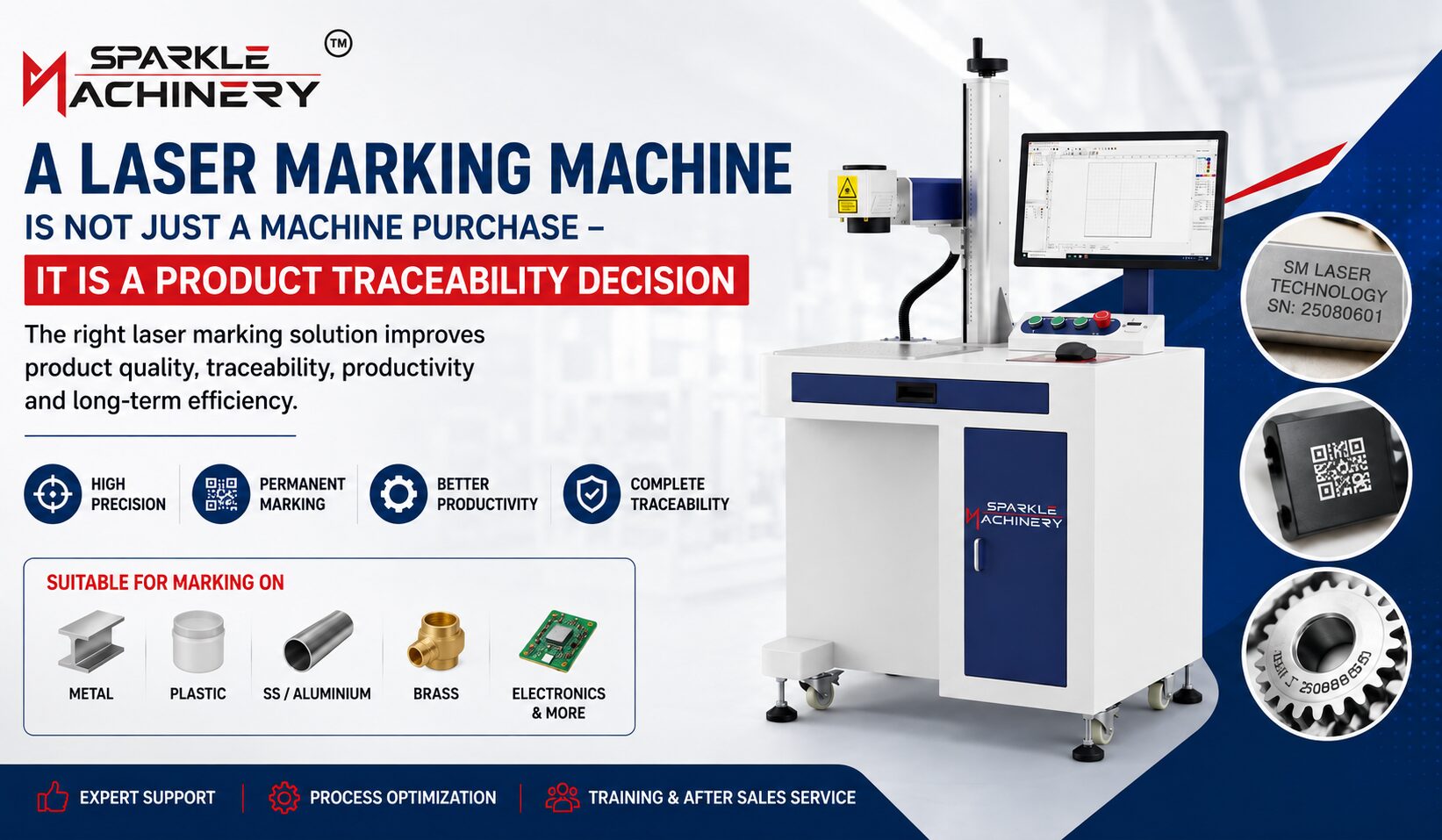
A laser marking machine is much more than a piece of industrial equipment. It directly affects your product quality, production speed, traceability, maintenance costs, and customer satisfaction.
Choosing the wrong machine can lead to slower production, poor marking quality, unnecessary investment, or limited future scalability.
At SM Laser Technology, we believe manufacturers shouldn’t simply buy machines—they should invest in the right permanent laser marking solution that supports their business growth for years to come.
Every Industry Has Different Marking Requirements
Not every manufacturing process is the same.
Before recommending any fiber laser marking machine or UV laser marking machine, we first understand the customer’s production environment.
Some of the most important questions include:
- What material needs to be marked?
- Is the product made of metal or plastic?
- What marking quality is required?
- Is the marking only for identification, or does it require branding?
- What is the production volume?
- Will automation be required in the future?
- Is portability important?
These questions determine whether a customer needs a:
- Metal laser marking machine
- Plastic laser marking machine
- Desktop laser marking machine
- Portable laser marking machine
- Handheld laser marking machine
- Table top laser marking machine
- Industrial laser marking system
Instead of selling the highest-power machine, our goal is to recommend the most suitable solution.
Step 1: Understand Your Production Process
Every production line has unique challenges.
For example:
A small manufacturing company may only require occasional marking of stainless steel nameplates.
An automotive supplier may need continuous high speed laser marking for thousands of components every day.
An electronics manufacturer may require ultra-fine marking on delicate PCB components.
A medical device manufacturer may need permanent UDI codes with extremely high precision.
Each application requires a different marking approach.
Understanding production requirements helps determine:
- Laser power
- Working area
- Automation requirements
- Fixture design
- Software integration
- Future expansion capability
Without this analysis, selecting a machine becomes guesswork.
Step 2: Choose the Right Laser Technology
Many buyers assume that every laser marking machine works the same way.
In reality, different laser technologies are designed for different materials.
Fiber Laser Marking Machine
A fiber laser marking machine is ideal for:
- Stainless steel
- Mild steel
- Aluminum
- Brass
- Copper
- Titanium
- Iron
- Carbide tools
Applications include:
- Serial numbers
- QR codes
- Barcodes
- Logos
- Nameplates
- Automotive components
- Industrial tools
Fiber laser technology delivers:
- High speed
- Permanent markings
- Minimal maintenance
- Long laser life
- Excellent precision
It is one of the most widely used industrial laser marking systems in manufacturing.
UV Laser Marking Machine
Certain materials cannot be marked effectively using fiber lasers.
This is where a UV laser marking machine becomes the preferred solution.
Popular models include:
- 5W UV laser marking machine
- 10W UV laser marking machine
UV lasers are ideal for:
- Plastics
- Medical devices
- Glass
- Acrylic
- Silicone
- Flexible packaging
- Electronic components
Because UV lasers produce very little heat, they minimize burning, melting, or discoloration.
Step 3: Match Laser Power to Your Application
One of the most common questions we receive is:
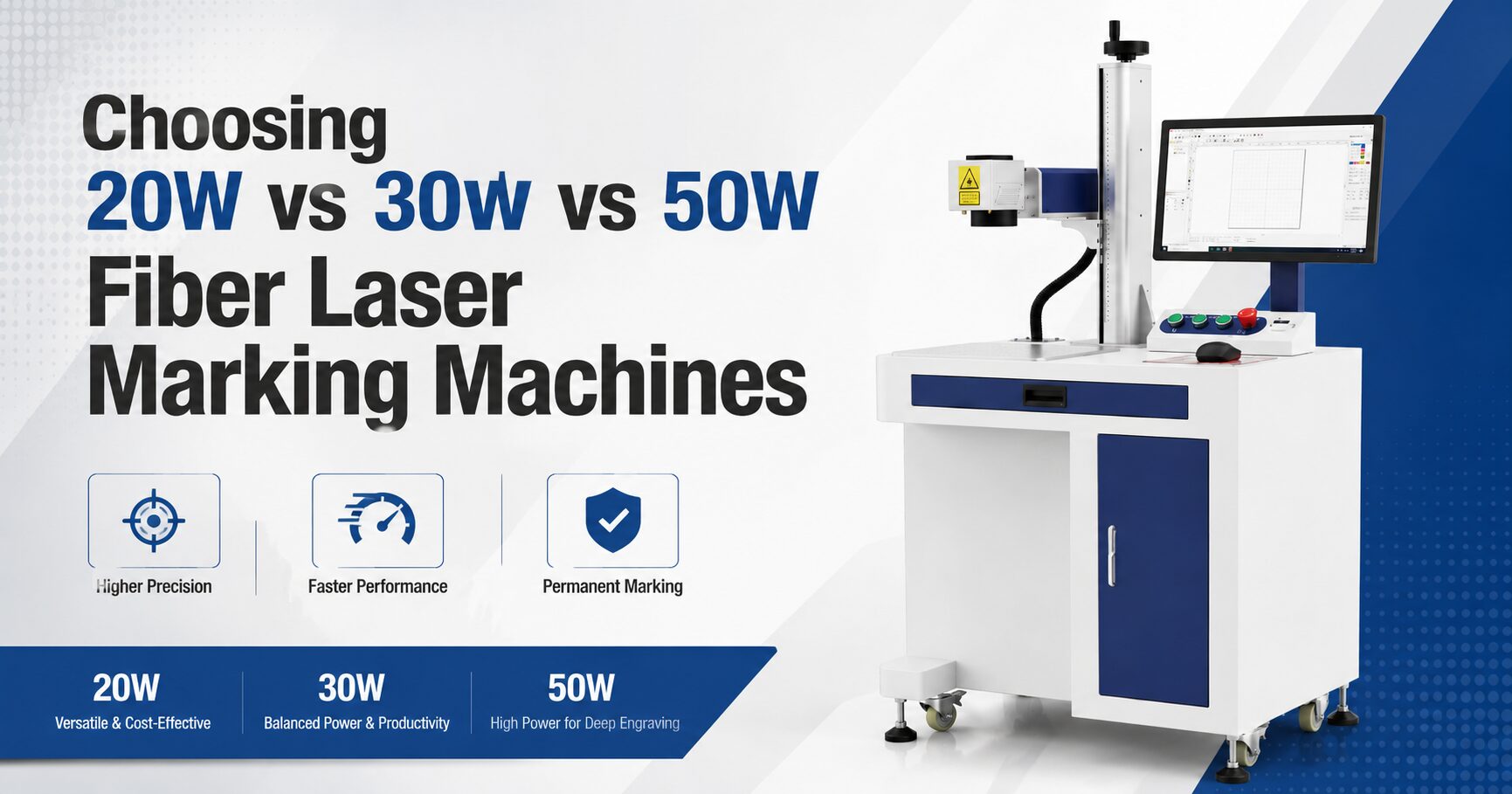
Which power should I choose—20W, 30W, or 50W?
The answer depends entirely on your application.
20W Fiber Laser
Suitable for:
- Basic identification marking
- Logos
- Serial numbers
- QR codes
- Light engraving
Ideal for manufacturers with moderate production requirements.
30W Fiber Laser
Recommended for:
- Faster production
- Deeper engraving
- Better efficiency
- Medium to high-volume manufacturing
This is one of the most versatile choices across industries.
50W Fiber Laser
Best suited for:
- Deep engraving
- Heavy industrial applications
- Hard metals
- Faster cycle times
- Large-scale manufacturing
Higher power does not automatically mean a better investment.
Selecting unnecessary power may increase costs without improving productivity.
Step 4: Consider Future Production Growth
Many businesses purchase machines based only on current production.
However, manufacturing requirements often increase over time.
Ask yourself:
- Will production double next year?
- Will automation be introduced?
- Will new products be added?
- Will traceability requirements increase?
Choosing a scalable industrial laser marking system today can eliminate expensive upgrades later.
Step 5: Verify the Marking Process Before Purchase
One of the biggest mistakes manufacturers make is purchasing equipment without testing their actual components.
At SM Laser Technology, we recommend performing sample testing before making a decision.
Testing helps verify:
- Marking quality
- Cycle time
- Depth
- Contrast
- Barcode readability
- Production speed
Whether you’re purchasing a logo marking laser machine, a barcode laser marking machine, or a complete industrial solution, real-world testing minimizes investment risk.
Step 6: Installation Is Only the Beginning
Buying a machine is only the first step.
The real value comes from successfully integrating it into production.
A professional supplier should provide:
- Installation support
- Machine commissioning
- Operator training
- Process optimization
- Software guidance
- Ongoing technical assistance
This ensures that the machine performs efficiently from day one.
Step 7: Build a Repeatable Marking Process
Consistency is critical in manufacturing.
Once the optimal marking parameters are established, they should be documented and saved.
Modern laser engraving marking machines allow operators to store:
- Power settings
- Frequency
- Speed
- Hatch parameters
- Focus position
- Job files
This reduces setup time and ensures consistent results, regardless of the operator.
Selecting the Right Machine Configuration
Different industries require different machine designs.
Depending on production needs, manufacturers can choose from:
Desktop Laser Marking Machine
Ideal for laboratories, workshops, and compact production environments.
Table Top Laser Marking Machine
Suitable for medium-volume manufacturing with ergonomic operation.
Portable Laser Marking Machine
Perfect for marking large or immovable components directly on-site.
Handheld Laser Marking Machine
Designed for applications where mobility and flexibility are essential.
Each configuration offers unique advantages depending on workspace, production volume, and component size.
Common Applications Across Industries
Modern laser marking systems are widely used in:
- Automotive components
- Aerospace parts
- Electrical panels
- Electronics manufacturing
- Battery production
- Medical devices
- Industrial tools
- Packaging
- Consumer goods
- Engineering products
Typical marking applications include:
- Serial numbers
- QR codes
- Data Matrix codes
- Logos
- Product identification
- Traceability codes
- Batch numbers
- Manufacturing dates
- Compliance markings
These permanent markings improve product traceability, quality control, and brand visibility.
Understanding Laser Marking Machine Price in India
Many buyers search for the laser marking machine price India before understanding their actual requirements.
Pricing depends on several factors, including:
- Laser source type
- Laser power (20W, 30W, 50W)
- Fiber or UV technology
- Machine configuration
- Working area
- Rotary attachments
- Vision systems
- Automation features
- Software capabilities
Rather than selecting the lowest-priced machine, businesses should evaluate the total value, long-term reliability, service support, and productivity improvements the system offers.
Why the Right Supplier Matters
A reliable supplier does much more than deliver equipment.
They help manufacturers:
- Select the right laser technology
- Test actual components
- Optimize marking parameters
- Train operators
- Integrate with production lines
- Provide after-sales service
- Support future automation
This partnership ensures the machine continues to deliver value long after installation.
Conclusion
A laser marking machine is not simply another capital investment—it is a strategic production decision.
Whether you need a fiber laser marking machine, UV laser marking machine, metal laser marking machine, plastic laser marking machine, desktop laser marking machine, portable laser marking machine, or a fully integrated industrial laser marking system, the right choice depends on your materials, production goals, and future growth plans.
At SM Laser Technology, we believe every customer deserves more than just a machine. We work closely with manufacturers to understand their application, verify the marking process, recommend the right solution, and provide ongoing technical support.
Because the true value of a laser marking system is not measured by its power or price—it is measured by how efficiently, accurately, and consistently it helps your production succeed.